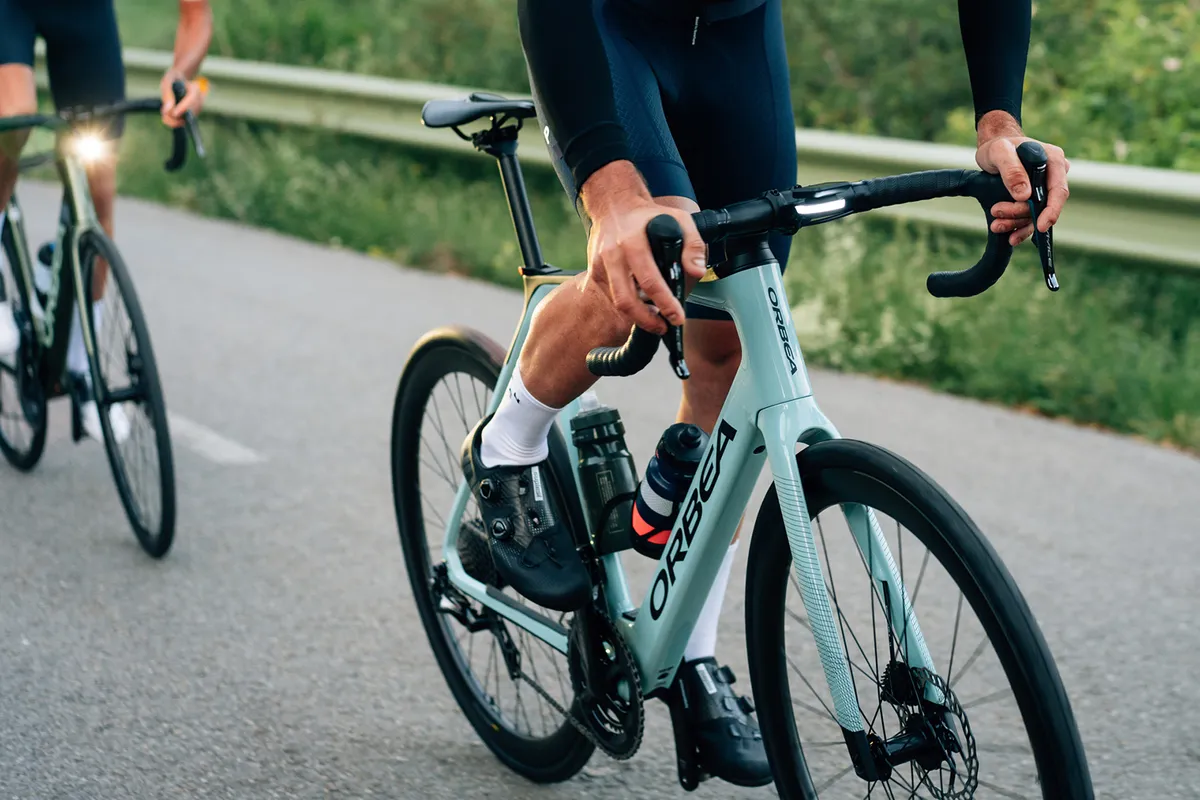
After conquering the mountain and trekking bike market, the triumphant march of motorised two-wheelers Click here didn’t stop at drop-bar bikes either. We’ve had a few E-road bikes make guest appearances in the editorial office during the past few months, like the SCOTT Addict eRIDE (review here), the Orbea Gain M20i (review here), the Trek Domane+ LT 9 (review here), the Canyon Endurace:ON AL 7 (review here), the Specialized S-Works Turbo Creo SL (review here), the Wilier Cento1 Hybrid (review here) and the Cannondale Synapse NEO SE (review here).
And with the HPS Domestique 1-21, you already have an E-road bike that is claimed to weigh just 8.5 kg! Fit riders who would normally get up moderate climbs on their analogue road bike at speeds faster than 25 km/h will be slowed down by the additional weight of the motor on an E-road bike, forcing them to ride below the 25 km/h threshold.
However, the added weight becomes negligible in flat terrain. Here, you’ll still be able to stick with a group when going over the 25 km/h threshold. Less trained roadies can benefit from the support of the motor in many situations. When riding an E-road bike, climbs that used to be out of reach no longer pose a problem and all-day rides suddenly become possible.
We know that reach is a hot topic when it comes to ebikes. However, there’s no way of making any reliable statements on this as the range depends on various factors such as the riding style, the rider’s weight and the distance ridden above the 25 km/h limit. For example, if you climb a 20 km alpine pass in the highest support mode, your range is likely to be limited to these 20 kilometres.
On the other hand, if you ride on flat roads with long stretches where you’re going over 25 km/h, you’ll be able to cover 150 km with the same bike and battery. To delve deeper into this topic, we recommend reading “The truth about lab tests” in our sister magazine E-MOUNTAINBIKE. For a group test of the most common E-road motors like the MAHLE or FAZUA, check out this article (E-road motor group test).
Road bike fit & feel – Choosing the right frame size
Companies such as Retül, Bikefitting, Trek Precision Fit and other bike fitting providers can help you find the right geometry and dial in the fit. For more information on the topic of bike fitting, we recommend checking out our article “The truth about bike fitting“.
When it comes to determining the frame size, there’s much more to consider than just leg length. The torso and arm lengths also play a critical role. There’s an online frame size calculator available at jensonusa.com that takes all the important body proportions into account.
Of course, if the frame size doesn’t fit perfectly or the geometry isn’t entirely optimal for the respective rider, the riding position can still be tuned via the stem length or angle and the offset of the seat post. However, this is no substitute for the correct frame size! If you can, you should definitely take the bike for a test ride before buying. If the bike of your choice isn’t available to ride, you can test ride an alternative model with similar geometry.
Fortunately, companies have started offering off the shelf road bikes for very small riders. The Canyon Aeroad CFR 9 Di2 (review here) comes in a total of eight frame sizes and size 3XS, which rolls on 27.5″ wheels, is perfect for people who are shorter than 1.60 m. Pinarello have gone even further with the DOGMA F (review here), which is available in no less than 11 frame sizes.
The latest generation of the Specialized S-Works Tarmac (review here) is also available in seven frame sizes from 44 to 61. With frames this small, you should watch out for toe overlap where your foot can get in the way of the front wheel when turning. If you’re between sizes, choose the larger frame for long rides or multi-day trips to benefit from the added composure, but go for the smaller and more agile frame if you’re more into short, intense sessions.
 Site Title
Leave a comment